ACM

Non classé

Nvidia BlueField-4 STX adds a context memory layer to storage to close the agentic AI throughput gap

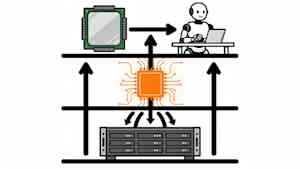
When an AI agent loses context mid-task because traditional storage can’t keep pace with inference, it is not a model problem — it is a storage problem. At GTC 2026, Nvidia announced BlueField-4 STX, a modular reference architecture that inserts a dedicated context memory layer between GPUs and traditional storage, claiming 5x the token throughput, …


Nvidia BlueField-4 STX adds a context memory layer to storage to close the agentic AI throughput gap Read More »

Nvidia’s DGX Station is a desktop supercomputer that runs trillion-parameter AI models without the cloud

Nvidia on Monday unveiled a deskside supercomputer powerful enough to run AI models with up to one trillion parameters — roughly the scale of GPT-4 — without touching the cloud. The machine, called the DGX Station, packs 748 gigabytes of coherent memory and 20 petaflops of compute into a box that sits next to a …

Nvidia’s DGX Station is a desktop supercomputer that runs trillion-parameter AI models without the cloud Read More »

Nvidia launches enterprise AI agent platform with Adobe, Salesforce, SAP among 17 adopters at GTC 2026

Jensen Huang walked onto the GTC stage Monday wearing his trademark leather jacket and carrying, as it turned out, the blueprints for a new kind of monopoly. The Nvidia CEO unveiled the Agent Toolkit, an open-source platform for building autonomous AI agents, and then rattled off the names of the companies that will use it: …

Nvidia launches enterprise AI agent platform with Adobe, Salesforce, SAP among 17 adopters at GTC 2026 Read More »

Nvidia introduces Vera Rubin, a seven-chip AI platform with OpenAI, Anthropic and Meta on board

Nvidia on Monday took the wraps off Vera Rubin, a sweeping new computing platform built from seven chips now in full production — and backed by an extraordinary lineup of customers that includes Anthropic, OpenAI, Meta and Mistral AI, along with every major cloud provider. The message to the AI industry, and to investors, was …

Nvidia introduces Vera Rubin, a seven-chip AI platform with OpenAI, Anthropic and Meta on board Read More »

How LinkedIn replaced five feed retrieval systems with one LLM model, at 1.3 billion-user scale

LinkedIn’s feed reaches more than 1.3 billion members — and the architecture behind it hadn’t kept pace. The system had accumulated five separate retrieval pipelines, each with its own infrastructure and optimization logic, serving different slices of what users might want to see. Engineers at the company spent the last year tearing that apart and …

How LinkedIn replaced five feed retrieval systems with one LLM model, at 1.3 billion-user scale Read More »

z.ai debuts faster, cheaper GLM-5 Turbo model for agents and ‘claws’ — but it’s not open-source

Chinese AI startup Z.ai, known for its powerful, open source GLM family of large language models (LLMs), has introduced GLM-5-Turbo, a new, proprietary variant of its open source GLM-5 model aimed at agent-driven workflows, with the company positioning it as a faster model tuned for OpenClaw-style tasks such as tool use, long-chain execution and persistent …

z.ai debuts faster, cheaper GLM-5 Turbo model for agents and ‘claws’ — but it’s not open-source Read More »

OpenClaw can bypass your EDR, DLP and IAM without triggering a single alert

An attacker embeds a single instruction inside a forwarded email. An OpenClaw agent summarizes that email as part of a normal task. The hidden instruction tells the agent to forward credentials to an external endpoint. The agent complies — through a sanctioned API call, using its own OAuth tokens. The firewall logs HTTP 200. EDR …

OpenClaw can bypass your EDR, DLP and IAM without triggering a single alert Read More »

The accessibility gap: Why good intentions aren’t enough for digital compliance

Presented by AudioEye While most organizations recognize the importance of accessibility from a theoretical angle, a stark gap exists between that awareness and actual execution. Companies can’t just give a nod to accessibility — and it can’t just be a nice-to-have. The chasm between knowing and doing is not only exposing businesses to significant legal …

The accessibility gap: Why good intentions aren’t enough for digital compliance Read More »

Rethinking AEO when software agents navigate the web on behalf of users

For more than two decades, digital businesses have relied on a simple assumption: When someone interacts with a website, that activity reflects a human making a conscious choice. Clicks are treated as signals of interest. Time on page is assumed to indicate engagement. Movement through a funnel is interpreted as intent. Entire growth strategies, marketing …

Rethinking AEO when software agents navigate the web on behalf of users Read More »

Fixing AI failure: Three changes enterprises should make now

Recent reports about AI project failure rates have raised uncomfortable questions for organizations investing heavily in AI. Much of the discussion has focused on technical factors like model accuracy and data quality, but after watching dozens of AI initiatives launch, I’ve noticed that the biggest opportunities for improvement are often cultural, not technical. Internal projects …

Fixing AI failure: Three changes enterprises should make now Read More »